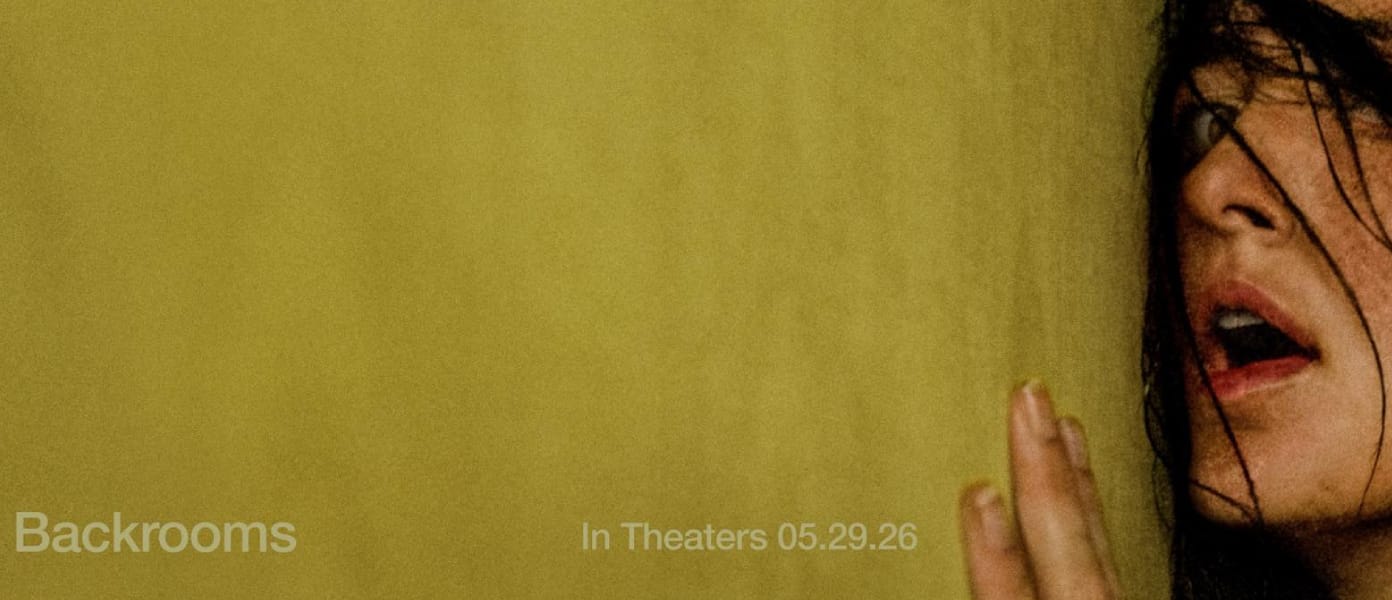
The Backrooms movie is incredible because it does something horror is uniquely built to do. It turns an invisible fear into a place you can walk through.
My 13-year-old daughter had been waiting for this movie since it was announced. She sent a group chat to me, her dad, her brothers, and her sister (for those who know my family she thinks of her oldest brother’s girlfriend as her sister, just as I consider her my daughter) saying we needed to get tickets this past weekend. Not asked. Announced. Tiny horror publicist with a phone and a mission.
She walked into Backrooms expecting one kind of movie, because she knows the Backrooms the way many kids her age know them: through games, YouTube, internet lore, liminal-space videos, and the shared online language of “no-clipping” out of reality.
I walked in more cautiously. I knew enough to realize I actually had no idea what to expect, but I do not like jump scares because they leave my body feeling tense for HOURS after.
I walked out feeling stunned. Yes, Backrooms has scary moments, and yes, I looked through my fingers during one scene. It also does something genuinely impressive by turning an internet myth into a theatrical horror film. But what stayed with me most was the storytelling, and the theory I walked out carrying, one I cannot prove, but cannot shake:
Backrooms is a movie about an unraveling mind.
More specifically, this first film feels like a horror story about memory loss, dementia, mental illness, caregiving, trauma, and the terrifying impossibility of explaining what is happening inside a brain while it is happening to you.
I found no reliable public evidence that Kane Parsons has explicitly tied this movie to dementia. But Parsons has talked about Backrooms in relation to memory, psychology, liminal spaces, and the way humans attach meaning to places. In an interview with The Playlist, he described the film’s psychology as running parallel to the physical mechanics of human memory, and he spoke about memory as the way people connect pieces of their lives into context.
I’ve talked about mental illness quite a bit on this site. I’ve talked about C-PTSD, therapy, and the tiny rooms that make up my own mind. Which, now, after seeing this movie, is kind of freaking me out a bit.
Who Is Kane Parsons?
Kane Parsons, also known online as Kane Pixels, is the young filmmaker behind Backrooms. A24 lists Parsons as the director, Will Soodik as the writer, and Chiwetel Ejiofor and Renate Reinsve among the stars. The official A24 synopsis is almost rude in how little it gives away, but I respect the simplicity now that I know how complex the story really is. “A strange doorway appears in the basement of a furniture showroom.”
The Internet Myth Becomes a Movie
Parsons’ path to that strange doorway began years earlier. His viral YouTube work grew from the Backrooms concept, which traces to internet creepypasta and a 2019 4chan-born image/post about an endless fluorescent maze. The Associated Press describes the film as an adaptation of that internet meme turned urban legend, with Parsons bringing liminal-space horror to the big screen.
People Magazine reported that Parsons was still in high school when his Backrooms project became a feature-film opportunity, and that he chose the A24 deal instead of a more traditional college path. The outlet also reported that the film stars Renate Reinsve, Chiwetel Ejiofor, and Mark Duplass, and is based on Parsons’ viral YouTube series inspired by the 4chan meme.
The remarkable thing about Backrooms is not that a 20-year-old made something surprisingly competent. That compliment feels too small, like handing someone a participation trophy after they built a haunted cathedral out of beige carpet and existential dread.
The remarkable thing is that a young creator seems to understand something older people often struggle to articulate: the horror of being trapped inside a system that keeps changing while you are still trying to understand the first rule.
A hallway. A memory. A symptom. A pattern. A room that looks almost like one you know.
The Movie My Child Expected, and the Movie I Saw
For younger viewers, Backrooms comes preloaded with expectations. It is internet horror. It is game-adjacent. It is a meme, a maze, a survival concept, a digital campfire story. For those who wanted that, they might be disappointed in what they actually got. Or maybe they didn’t deep dive into a metaphorical reflective pool afterward like I did.
The film does not simply give audiences monsters in hallways. It gives us Clark, played by Chiwetel Ejiofor, and Mary, played by Renate Reinsve. Clark is a furniture-store owner or manager who disappears into the Backrooms, while Mary is the therapist who tries to reach him.
That relationship changes the whole concept of the movie from a game to reality.
Clark Is Not Just Lost in a Place
Clark is not merely lost in the Backrooms. He is lost in himself.
And I want to be careful here, because Clark does seem to want help. He tapes off the door for Mary. He calls her from inside the Backrooms. Some part of him is reaching out. Some part of him knows he is trapped. Some part of him wants another person to see what is happening.
That is what makes it so heartbreaking.
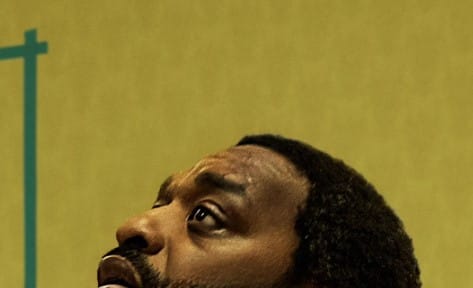
Because wanting help and being able to change are not always the same thing.
Clark reaches for Mary, but he also keeps retreating deeper into the rooms. He wants someone to witness the maze, but he cannot seem to leave it. Or maybe he cannot fully imagine life outside it anymore. Maybe his brain cannot build that pathway. Maybe the injury, illness, grief, fear, shame, or whatever is happening inside him has altered the structure too much.
And yes, the symbolism lands harder when you remember what Clark wanted to be: an architect.
That is one of the mysteries science still has not fully solved for us. We can see parts of the brain. We can study neurons, synapses, patterns, chemicals, injury, memory, behavior. We can name some symptoms and track some decline. But we still cannot fully explain why one person can reach for change and another person, with just as much need and maybe just as much longing, cannot cross that threshold.
The space seems to understand Clark, copy him, rearrange him, and trap him in loops. Pathways repeat. Details shift. Lights flicker. Switches no longer do what they are supposed to do. The familiar becomes unreliable.
That is what made me think of dementia, specifically.
I want to be careful with that word, so I’ll come back to it in a moment. I am not diagnosing Clark, and I am not claiming this is what Parsons intended. I am saying the metaphor hit me hard because the Backrooms behave like a place where the mind’s familiar pathways have stopped behaving predictably.
You turn a corner and think you know where you are. You do not. You follow the same path and something is different. You reach for the switch and it no longer does what it once did. The lights hum. The walls repeat. The room is almost recognizable, but the context is gone.
That is not just a scary setting.
That is a profound horror.
Mary, Caregiving, and the Ache of Trying to Reach Someone
Mary is essential to this interpretation.
She is not just a therapist character dropped into the plot to ask concerned questions in soft lighting. She is someone who seems shaped by mental illness in her own family. The glimpses of her mother matter. Mary was raised close to instability, close to suffering, close to a kind of disorder she could not fix as a child.
So she becomes someone who tries to help others.
That is painfully human. Many people who grow up around untreated illness, addiction, trauma, or cognitive decline become hyper-attuned to other people’s pain. Some become helpers. Some become rescuers. Some become professionals. Some become all three, which is a very expensive emotional subscription plan.
But Backrooms does not romanticize that impulse.
Help Is Not a Key That Works on Every Door
Mary wants to help Clark, and Clark seems to want help too, at least part of him does. He reaches for her, leaves signs, and calls from inside the maze. But wanting help and being able to receive it are not the same thing. He may want a witness more than he wants transformation, or maybe his brain simply cannot find the pathway back.
This is one of the most painful truths about loving or treating someone in psychological distress: help is not a key that works on every door.
You can stand outside someone else’s maze with a flashlight, snacks, boundaries, and the most sincere intentions on earth. That does not mean the maze opens. That does not mean the person inside can hear you. That does not mean love becomes a map.
Caregiving makes this especially brutal. Cue up “The Caretaker – Everywhere At The End Of Time.” Thank you, Grace, for telling me that this music existed.
The Alzheimer’s Association reports that nearly 13 million Americans provide unpaid care for a family member or friend with dementia. The CDC also notes that unpaid caregiving is a major public health issue, with tens of millions of U.S. adults supporting loved ones who are older or living with chronic conditions or disabilities.
Mary’s role echoes that unbearable position: standing outside someone else’s interior maze, trying to reach them, knowing the map keeps changing.
Captain Clark and the Self That Turns Against Itself
Then there is Captain Clark.
This is where the film becomes more than atmospheric horror. Captain Clark is not simply an entity. He reads like Clark, or part of Clark, or the performance of Clark made monstrous.
The Persona Becomes the Monster
That detail matters.
The persona is not random. It is a version of Clark he created, maybe to sell furniture, maybe to survive humiliation, maybe to turn himself into something more powerful than he felt. But in the Backrooms, that persona becomes autonomous. It becomes violent. It becomes the thing that destroys him.
To me, that is where the movie becomes a story about mental illness and self-destruction.
Not in a tidy clinical way. Not in a “let’s diagnose the fictional man in the haunted carpet maze” way. We are not doing that. My eyeliner is bold, but my boundaries are intact and I’ve dealt with my own inner conflict and mental warfare enough not to judge or try to explain something that I have not studied or lived personally.
Emotionally, though, the symbolism feels devastatingly clear: sometimes the part of a person that is suffering is not the same part that is willing to be saved.
Clark brings Mary into the Backrooms. He wants, at least on some level, to show her what is happening. But the part of him that is rage, shame, refusal, and collapse cannot accept help.
That is horror with teeth and claws.
Why Dementia Is Such a Powerful Lens for Backrooms
So, separately, outside of mental illnesses that we often hear about, like depression, schizophrenia, borderline personality disorder, and so many others. There are other illnesses that deeply impact the brain. Dementia is uniquely difficult to represent because it attacks the tools a person would need to explain it.
I am not in the medical profession, and I know dementia is not categorized as a mental illness. I am not using dementia, trauma, and mental illness as interchangeable terms, because they are not interchangeable. Dementia is a neurodegenerative condition that can affect cognition, memory, language, behavior, and daily functioning. Mental illnesses have their own distinct causes, experiences, treatments, and stigmas.
Dementia is also not a single disease. The CDC describes it as an overall term for decline in mental ability that interferes with daily life, affecting memory, thinking, and behavior. Alzheimer’s disease is the most common type of dementia. The Alzheimer’s Association similarly describes dementia as an umbrella term for symptoms caused by different diseases, including Alzheimer’s.
What I am trying to name is something broader and, frankly, more frightening: the brain itself is an incredibly powerful organ, and we still do not fully understand it. We can study neurons, synapses, memory, chemistry, trauma responses, cognitive decline, and behavior, but there is still so much mystery in how a person’s inner world is built, altered, protected, or lost.
That is why Backrooms feels terrifying to me. It turns the mystery of the brain into something you can wander into and may not know how to leave.
Dementia is uniquely difficult to represent because it attacks the tools a person would need to explain it.
A person may be able to describe early confusion, fear, or forgetfulness. But as dementia progresses, memory and language can become less reliable. The Alzheimer’s Association notes that dementia can involve memory loss, confusion, delusions, and hallucinations in some people.
That is the impossible bind: once you are deep enough inside the maze, you may no longer be able to describe the maze. You may no longer be able to escape it.
Backrooms literalizes that terror.
The Rules Keep Changing
The rooms are not just scary because they are endless. They are scary because their logic keeps slipping.
They are not irrational, exactly. They have rules. They have patterns. But the rules do not remain stable enough for the trapped person to master them.
That is what made the flickering lights and broken switches feel so loaded to me. In the Backrooms, a switch does not always do what a switch is supposed to do. A light flickers on, then off, then on again, like the space itself is trying to connect and misfiring.
And how does the brain work, really? Through neurons firing, signals passing across synapses, pathways lighting up so memory, language, recognition, and emotion can communicate with one another. When those pathways are disrupted, the familiar can become unreliable. The switch is still there. The room is still there. But the connection does not hold the way it used to.
That is why those details matter. The lights are not just atmosphere. The faulty switches are not just set dressing. They feel like a visual language for a brain struggling to send and receive its own messages.
That is what families often experience around dementia and severe mental illness, too. There are patterns. There are triggers. There are moments of recognition. There are moments when the person you love is there, and then suddenly somewhere else.
The light flickers on.
The light flickers off.
The film captures that feeling without turning it into a speech.
The Photocopies of Memory
One of the strongest ways to understand Backrooms is through the idea of memory as a photocopy of a photocopy.
We do not simply replay the past. We reconstruct it. We copy it, revise it, emphasize different details, lose some parts, sharpen others, and sometimes mistake the copy for the original.
That is not just sad, it is also deeply human.
The Backrooms Are Context Without Story
Parsons has connected liminal spaces to memories that feel unmoored from clear context. In The Playlist interview, he discussed early-life memories that are not quite linked to identifiable parts of life, which is exactly the kind of thought that makes the Backrooms feel less like a monster closet and more like a brain trying to file its own broken folders.
That is one of the best keys to the film.
The Backrooms are not just empty spaces. They are contextless spaces.
They feel like places from childhood, work, school, waiting rooms, basements, showrooms, offices, hotels, and dreams. But they are severed from the stories that would make them make sense.
A place without context becomes threatening.
A hallway without an origin or destination becomes a trap.
A room without meaning becomes a symptom.
Did Kane Parsons Intend This?
Here is the honest answer: I do not know.
I found no reliable public evidence that Parsons has said Backrooms is specifically about dementia or Alzheimer’s or a form of mental illness. I also found no reliable public evidence that he has disclosed a personal connection to these things.
The responsible claim is that Parsons made a movie about memory, psychological space, and the terror of watching meaning slip out of places that used to make sense. For viewers who have lived near dementia, mental illness, caregiving, or trauma, that horror may feel unmistakable.
What he has said is still deeply relevant.
Why Backrooms Matters
A lot of adults still underestimate internet-born art. They hear “Backrooms” and think meme. Game. YouTube. Kid stuff.
But young people’s horror is often where culture processes the things adults have failed to explain.
School fear. Climate dread. Algorithmic life. Isolation. Surveillance. Broken institutions. Family instability. Mental illness. The feeling that reality itself has trapdoors.
The Backrooms work because they are not just a monster world. They are a metaphor engine.
Gen Z Horror Is Telling Us Something
For a 13-year-old, the horror may begin with the thrill of recognizing a digital myth brought to life.
For a parent, it may become something else: a story about watching a person disappear inside themselves. A story about trying to help someone who cannot or will not come back. A story about the limits of care, language, and love.
And that is why the movie stayed with me.
It was not really about a game.
It was about the rooms behind the rooms. The hallways we inherit. The doors our families leave open. The ones we close. The ones that stop working. The ones we keep trying anyway.
And maybe that is why Backrooms feels so haunting. It understands that the scariest place is not always somewhere outside reality.
Sometimes it is the back room of your own mind.
And sometimes the bravest thing a person can do is keep looking for the exit without forgetting they deserved one in the first place.
If this subject touches something personal for you or someone you love, support exists. In the U.S., call or text 988 for immediate mental health crisis support.
Why Backrooms May Not Work for Everyone
I can understand why some people probably did not like Backrooms.
This is not your average horror movie. It is not built around clean jump scares, easy answers, or a monster who politely arrives on schedule so everyone knows when to scream. It is slower, stranger, and much more psychological. It asks the audience to sit in discomfort instead of releasing that discomfort every few minutes with a loud noise and a musical sting.
For some viewers, that may feel frustrating. If you go in wanting a traditional horror rhythm, Backrooms might feel too abstract, too quiet, or too unwilling to explain itself. It does not hand you a neat mythology packet with labeled tabs.
But for me, that is exactly why the whole concept was terrifying.
The horror is not only what might be hiding around the corner. The horror is the corner itself. The hallway. The repeated room. The switch that no longer behaves like a switch. The light that flickers like a thought trying to complete itself.
That kind of fear does not always make you jump out of your seat. Sometimes it follows you home, waits until the house is quiet and everyone has gone to bed, then taps you gently on the shoulder like, “Remember me?”
And I did.
The Official Trailer