
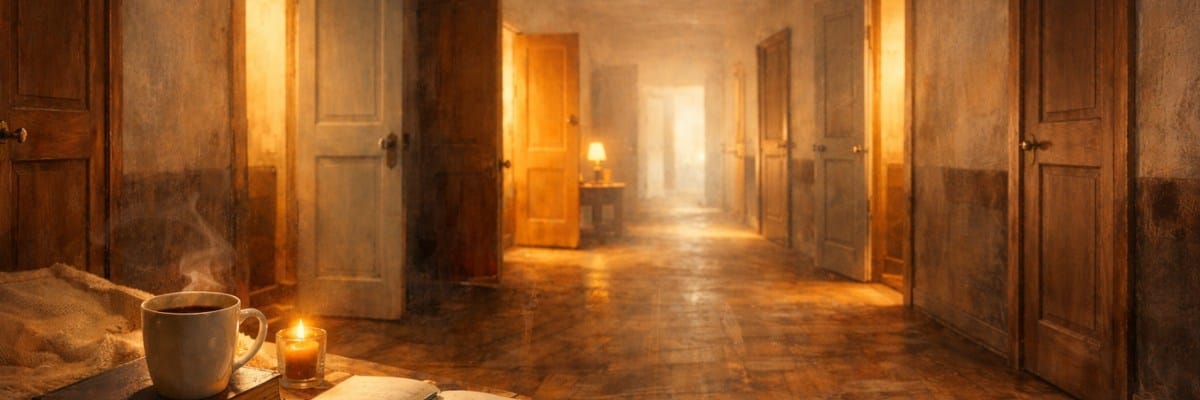
Saturday Mornings and the Truth That Slips Out
Saturday mornings have become a soft place for me.
Not because my life is soft. (Ha.) But because the ritual is: coffee for me, breakfast for her, and a conversation that somehow always finds the exact spot where I’m tender. My oldest son’s girlfriend and I talk like that. Quiet, real, unforced.
Recently, we talked about compartmentalization.
And I said it out loud, like a confession and a flex at the same time: I used to think I was really good at it.
Compartmentalization is my biggest defense mechanism. The way I cope. The way I keep going. Whether it’s healthy or not… well. That depends on the day and who you ask, doesn’t it?
Open Tabs vs. Tiny Rooms
Some people say their brain feels like a million open tabs, like a browser that won’t stop loading. And I get that. I do. I’ve lived there.
But lately it feels different.
Lately it feels like a hallway full of tiny rooms, each with its own door.
And here’s the truth that hurts:
There are rooms I keep shuttered with everything I’ve got.
And there are rooms I’m forced to enter and exit nearly every day.
Like I don’t even get a choice.
Like the pain has a schedule.
When Pain Has a Schedule
And it is exhausting. It is painful. It is conflicting in a way that makes you question your own sanity because how can something be so heavy and yet so routine? How can grief feel like a chore and a sacred thing at the exact same time?
Sometimes I want to ask the world, Do you understand how much effort it takes to look normal when you are required to walk back into rooms you did not choose, rooms your body still remembers, even if your mind is trying to move forward?
Because that’s what it’s like. It’s not that the pain is always screaming.
It’s that it’s always there.
It’s behind Door #3. And Door #7. And that one at the end of the hall that I pretend isn’t even part of the floor plan.
44 Going on 45, and Still Learning Survival
And I am 44. Going to be 45 in a few months.
Which means I am old enough to know that time does not magically fix anything. Time just shows you what you refuse to face. Or what you’re forced to face. Or what you keep trying to face, but only in tiny, shaking doses because that’s all your nervous system can handle without collapsing like a cheap lawn chair.
So I keep thinking:
Is there really a way to teach this old dog new tricks?
I don’t know.
Can I burn some of the rooms down? Nail the doors shut?
Can I sell the whole damn house and move into a studio apartment with one window and one plant and no trauma tucked into the baseboards?
Or am I destined to continuously revisit pain and trauma on a regular basis?
“Process It” Sounds Cute Until You Live It
That’s the part that gets me. The revisiting. The re-entering.
Because people love to say things like “you have to process it.”
Okay. Sure.
But what does that actually mean when the thing you’re processing isn’t a single event with a beginning and an end?
What does it mean when the pain isn’t a chapter. It’s a recurring theme.
When you can’t just “close the book,” because life keeps adding footnotes in the margins and the story is still unfolding and you’re still living it with your whole body?
That’s when compartmentalization stops being a helpful skill and starts feeling like emotional whiplash.
You go into the room. You shut the door. You smile.
You go into the room. You shut the door. You make dinner.
You go into the room. You shut the door. You answer texts.
You go into the room. You shut the door. You try not to cry in the car because a song comes on the radio that reminds me of times when things were different.
And then you wonder why you’re tired.
It’s not because you’re weak.
It’s because you’re doing an Olympic sport emotionally and nobody is handing out medals for “made it through the day without screaming into a pillow.”
Writing Is My Outlet… and My Second Guessing Machine
And writing is supposed to be one of the places I can exhale.
It is an outlet for me. It’s how I make sense of the mess. It’s how I take the sharp pieces of life and try to arrange them into something that won’t cut me every time I pick it up.
But here’s the twist. I don’t just write and feel better.
I write, and then I analyze every word.
I reread. I edit. I second-guess. I wonder how it sounds. I wonder how it lands. I wonder what people will infer, what they’ll assume, what they’ll twist into something I never meant.
I know who reads my content. By and large, the family and friends who even know it exists, and regularly check in, are probably quite few.
And yet somehow, those few take up a whole lot of space in my head.
Because I know sometimes my words bite. Not because I’m trying to be cruel, but because I’m telling the truth from inside the room. And the truth doesn’t always come out gentle. Sometimes it comes out like a bruise you didn’t know you had until someone touched it.
My words can bring up pain that nobody wants to feel.
The Question That Haunts Me: Do I Say It Anyway?
And then I’m stuck in this awful question:
Does it make sense not to say them?
Because if I don’t say them, if I soften everything until it’s palatable, if I silence the sharp edges, if I turn my honest life into something easier for other people to swallow, doesn’t that put me right back in the same place?
That old familiar place where everyone else gets to deem how I should be feeling.
What I should be doing.
How long grief is allowed to last.
How quickly I should be “over it.”
How “letting go” is treated like some magical button I’m refusing to press.
And then it gets even messier, because I don’t always know what’s real and what’s fear.
Is that what’s actually happening in real life?
Or is that what’s happening in my mind?
Because those are two different things, and when you’re already exhausted, they can look identical.
The Ripple Effect of Every Choice
Every decision I make has consequences, and they often don’t just hurt or help me. They branch out and touch the lives of people I care about.
And sometimes that branching feels so big, so loud, so heavy, that I stop caring what is happening in my mind or in my heart. I’m focusing on doing what I think needs to be done for everyone else.
I’ve done that for so long it feels like muscle memory.
Like my default setting is: manage everyone else first.
And if I’m honest, really honest, I think I’ve become so practiced at being the steady one, the functional one, the “I’ve got it” one, that I’ve trained myself out of being a person with needs.
Which is ironic, because I’m out here writing about feelings while simultaneously trying to outrun my own.
Boundaries: Turns Out I’m Still Learning
So then we talked about boundaries.
And I laughed a little, because I genuinely believed I had learned how to set them.
I thought I did.
I’ve read the things. I’ve had the talks. I’ve practiced the sentences in my head. I’ve said “no” and watched people react like I slapped them with a wet towel. I’ve done all that.
But lately it’s become obvious: I’m not as good at boundaries as I thought.
Or maybe, here’s the more honest version. I’m good at boundaries when the stakes are low.
I’m good at boundaries when it’s inconvenient but not devastating.
But when it comes to pain? When it comes to trauma? When it comes to the rooms I didn’t build but still have to live with?
That’s where I get messy.
When the Boundary I Need Is With My Own Mind
Because sometimes the boundary I need is not about other people.
Sometimes the boundary is with my own mind.
Sometimes I need a boundary that says:
“Not today.”
“Not like this.”
“Not without support.”
“Not without rest.”
“Not while I’m already bleeding.”
And that’s where it gets complicated, because life doesn’t always respect emotional boundaries. Responsibilities don’t care if your nervous system is fried. The calendar does not pause because your heart is heavy.
Motherhood and the Habit of Disappearing
And my kids are a whole universe of this.
Because I have always put their well-being above my own. Always. It’s not even a debate inside me. It’s like breathing.
So when someone asks how I’m doing, I give the answer that’s safe. The answer that doesn’t cause a ripple. The answer that keeps the hallway quiet.
“I’m hanging in there.”
Or I pivot, like I always do, into how my kids are doing.
Because if they’re okay, then I can be okay, right?
Except that’s not actually how it works.
That’s just how I’ve survived.
And I keep hoping that someday, somehow, when someone asks me how I am, I’ll be able to answer honestly with more than “hanging in there.”
Not because I want to be dramatic.
But because I want to be real.
Because I want to stop living like my honesty is a liability.
Maybe the Goal Isn’t to Burn the Rooms Down
So what do we do?
I don’t have a neat answer. I wish I did. I wish I could wrap this up with a bow and a lesson and three bullet points, because I love clarity. I love a plan. I love the illusion of control. (Don’t we all?)
But here’s what I’m learning, slowly, begrudgingly, like someone being taught to swim by being tossed into the deep end:
Maybe the goal isn’t to burn the rooms down.
Maybe the goal is to stop entering them alone.
Maybe the goal is to bring a lamp.
Maybe the goal is to stop pretending the house doesn’t exist.
Because the truth is, the rooms are there for a reason. Some were built by survival. Some by love. Some by loss. Some by things we didn’t choose.
And when you’ve survived hard things, compartmentalization can be a kind of genius. It can be the thing that keeps you functioning when you’re drowning.
But survival mechanisms are not always meant to be lifelong architecture.
At some point, coping becomes cramped.
At some point, the house becomes a maze.
And you start to realize you don’t just want to endure your life.
You want to live it.
Self-Love Isn’t Soft. It’s a Boundary.
And to live it, you have to make space for the truth, without letting the truth consume you.
Which brings me to something I don’t hear enough people say:
Self-love is not bubble baths and affirmations.
Sometimes self-love is writing the thing anyway.
Sometimes self-love is letting your words be honest even if they make someone uncomfortable, because discomfort isn’t always danger. Sometimes it’s just growth. Sometimes it’s the truth finally getting air.
Sometimes self-love is saying, “My feelings are not up for debate.”
Sometimes self-love is learning the difference between being responsible to people and being responsible for their emotions.
Sometimes self-love is saying, “I can’t go in that room today.”
Sometimes self-love is making an appointment and keeping it.
Sometimes self-love is admitting you’re exhausted instead of pretending you’re fine.
Self-love is not the opposite of pain.
Self-love is the thing that helps you walk through pain without abandoning yourself.
Not Alone. Not Anymore.
And that’s what I want. That’s what I’m reaching for, even when it’s ugly and uncomfortable and slow.
Because I don’t want to keep living like I’m sprinting between doors, trying to outrun what’s behind them.
I want to learn a different way.
A way that doesn’t require me to be numb in order to be strong.
A way that doesn’t require me to be shut down in order to be functional.
A way that makes space for the raw and the painful, without making it my entire identity.
So no, I don’t know if you can teach an old dog new tricks.
But I do know this:
I have learned hard things before.
I have survived hard things before.
And the fact that I’m asking these questions at 44, almost 45, doesn’t mean I’m behind.
It means I’m awake.
It means I’m ready to stop calling coping “living.”
And if you’re reading this and you have your own hallway of rooms, your own doors, your own shutters, please hear me:
You are not broken because you had to build a house like this.
You are not weak because some rooms still hurt.
You are human.
And there is courage in choosing to be kind to yourself while you figure it out.
Even if all you can do today is crack the door open and whisper, “Not alone. Not anymore.”




I see you…daughter of mine.
Very vulnerable and I suspect much more universal than you might think. When I was young I had a book called The Woman With 2 heads. Some days it feels like many more than 2. I enjoyed your brave words and relate. From your family’s old friend.