
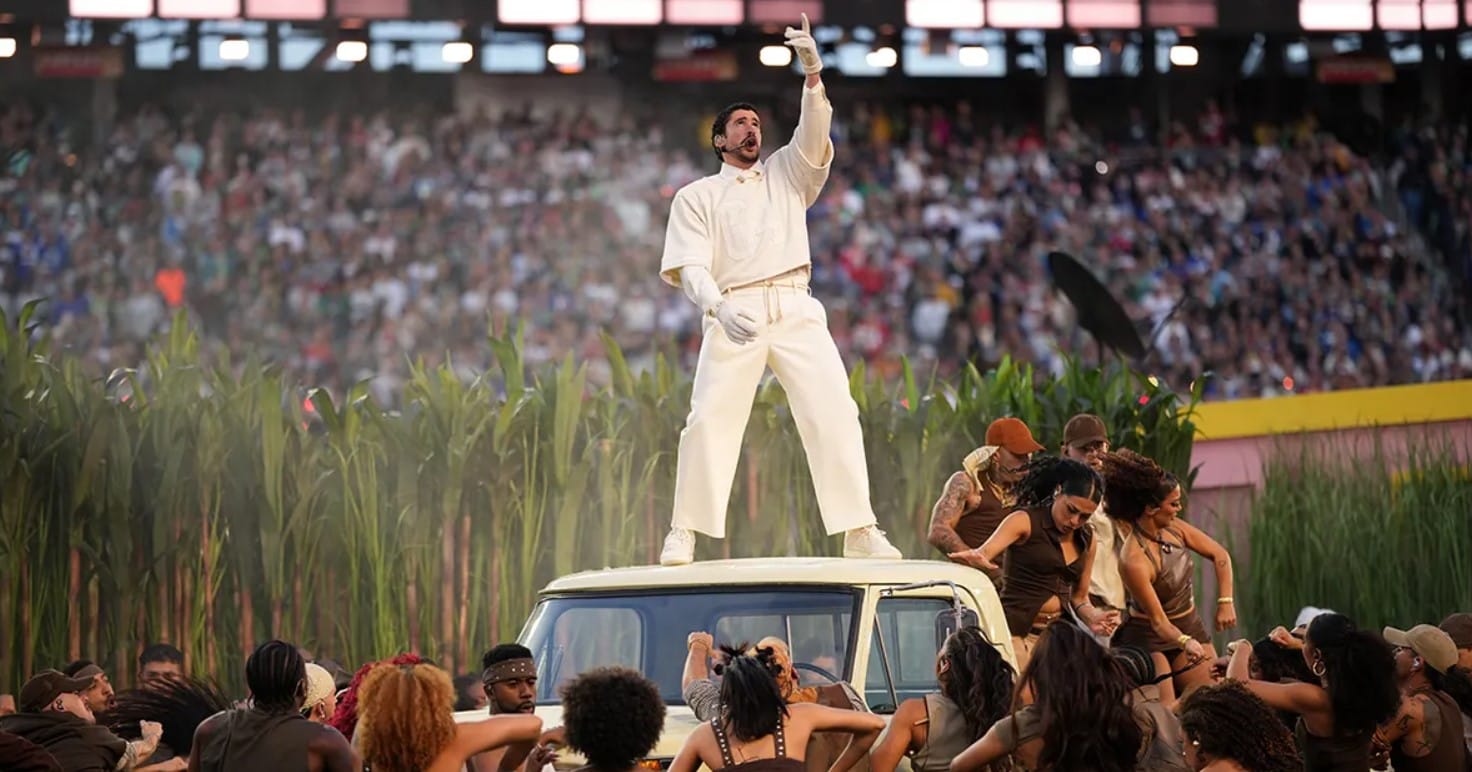
The Bad Bunny Super Bowl halftime show hit me in a way I did not see coming, and yes, I am fully aware that I am the person who still talks about Prince in the rain like it is a religious experience. Prince’s 2007 halftime set was perfect. Iconic. Untouchable. And still, last night at Super Bowl LX, Bad Bunny walked out at Levi’s Stadium and somehow made the biggest stage in American football feel like a porch light left on for you.
I did not know most of the songs. I do not speak Spanish. Two of my kids are learning it, my son’s girlfriend speaks it fluently, and Spanish lives in the air around me like background music. I should have learned the words a long time ago. And I felt that, sharply. Not guilt exactly, but that tight-chest awareness of what it means to be outside a language that belongs to millions of people who are absolutely part of this country.
And then Bad Bunny did something radical in its simplicity: he did not translate himself to be palatable. He invited us anyway.
The “I Don’t Speak Spanish” Moment That Turned Into Something Better
I watched from my living room, and instead of doing the usual halftime multitask spiral, I called out to all the kids like it was a weather alert. “Bad Bunny’s on!” Because that was the only part they cared about anyway since the Eagles were not playing. And then suddenly I was planted there, fully locked in, like the Super Bowl had finally started for our house.
Bad Bunny opened in a staged sugarcane field, with workers and dancers moving through it like memory. It was beautiful, and it was not neutral. Sugarcane is not just scenery. It is labor, colonial history, extraction, and survival. And I want to say this clearly and respectfully: I am naming symbolism as I experienced it while watching, not claiming I can speak for Puerto Ricans or for the island’s full history. I am a guest in this story, and I am trying to listen like one.
And here is the thing: I could not understand every lyric, but I understood the message. That is the part people keep missing when they complain about language like it is a barrier instead of a bridge. Music has always been fluent.
(Also, if you think English is the only “American” language, I have a history book and a side-eye waiting for you.)
Jump to my disclaimer if you want to start hating on the lyric translation.
Puerto Rico on the Biggest Stage, Not as a Backdrop but as the Point
What stunned me was not just the performance. It was the world Bad Bunny built.
The halftime set leaned into everyday Puerto Rico: a casita-style home, storefront energy, domino tables, the feeling of community that is not curated for tourists. It looked like family. It looked like neighbors. It looked like the kind of place where somebody’s auntie would yell “¿comiste?” before you even sit down.
When I say that, I mean it with affection and recognition, not as a stereotype. The point is that the show centered ordinary life as worthy of the biggest spotlight. It did not flatten Puerto Rico into a postcard. It treated it like a living place, with real people and real pride.
Design writers pointed out how intentional it all was, right down to the casita being modeled after a real home in Humacao and the stage scenes nodding to things like piragua vendors and nail salons. This was not “Latino vibes.” This was specificity.
And specificity is what makes people feel seen.
The Wedding Moment That Made Me Gasp and Then Grin
And then, about five minutes in, I saw a couple in a fancy white wardrobe, and my brain did that thing where it tries to protect you from joy by getting suspicious first. Is this a bit? Is this a sketch? Am I being pranked by the Super Bowl?
Nope. It was real.
Bad Bunny featured an actual wedding during his halftime show. A real couple got married on the field at Levi’s Stadium. There was a kiss. There was a crowd. There was a wedding cake. It was wildly tender and wildly bold, and it somehow fit the show perfectly because of course it did.
His representative confirmed Bad Bunny served as a witness and signed their marriage certificate. Let me say that again because it still feels fake in the best way: the headliner of the Super Bowl halftime show paused the biggest performance slot in America to witness two people choosing each other.
That is not just spectacle. That is community. That is love made public in a way that felt aligned with the show’s whole message: “We are here, we are connected, and we celebrate each other.”
“El Apagón” and the Symbolism That Made My Throat Tight
When “El Apagón” hit, it was not just a bop. It was a reminder.
Puerto Rico’s power crisis is not abstract. After Hurricanes Irma and Maria in 2017, the island experienced the longest blackout in U.S. history, with full restoration taking roughly 11 months for customers whose structures were safe to reconnect. That is not a fun fact. That is a trauma timeline, and I do not say that lightly.
Onstage, dancers climbed utility poles, a visual that made the point without turning into a lecture. The show managed to hold joy and anger at the same time, which is honestly one of the most human forms of storytelling there is.
Bad Bunny has used “El Apagón” before as a protest song and a critique of ongoing outages and political failures. So seeing that song centered here felt like: we are not decorating over the damage.
What Bad Bunny Stands For (And Why This Show Triggered a Culture War)
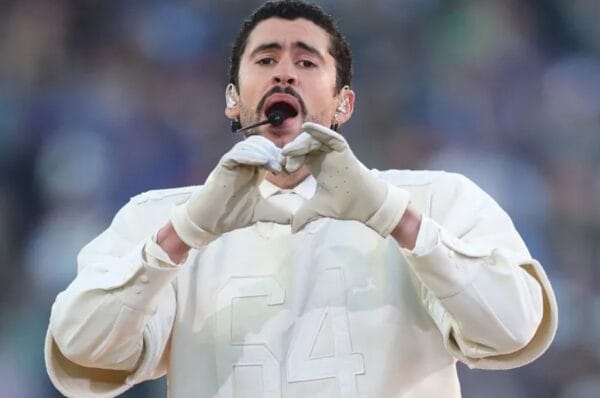
Let’s talk about what your gut already knows: this was not only about music. It was about power.
Bad Bunny has been outspoken about machismo and misogyny, and he has used his platform to challenge sexism and violence against women. He has also been tied, in a very real way, to Puerto Rican political conversations and identity debates. I am not here to appoint him a saint. I am here to acknowledge that he shows up, and that showing up comes with heat.
And last night, those values were not hidden in the fine print. There were explicit messages on the set, including a line reported on the stadium boards: “The only thing more powerful than hate is love.”
You do not have to agree with every stance to understand what he was doing there. He was saying: We are not asking to be tolerated. We are showing up as ourselves.
“It Didn’t Represent All of America” and Other Things People Say When They Mean “Not Me”
Nothing will ever represent all of America. That is not a failure. That is the whole assignment.
“All of America” is not one sound, one language, one genre, one flag, one kind of story. We are contradiction and collision and casserole recipes passed down next to protest chants. We are family room rituals, shifting demographics, and the constant argument about who counts.
Puerto Rico is part of the United States, and Puerto Ricans have long navigated a complicated relationship with citizenship, political power, and representation. So when Bad Bunny centers Puerto Rico on the Super Bowl stage, it is not “outside.” It is inside. It is family.
And if you turned off the game to watch the “fake show” alternative, I mean this with a warm hand on your shoulder and bold eyeliner energy: you did not boycott anything. You just missed a cultural moment. Also, you missed a wedding. That feels like a weird hill to die on, but live your truth, I guess.
The Part That Made Me Smile After: My Son, Spotify, and the Point of All This
After the show, my son was listening to Bad Bunny up in his room, I could hear it traveling down the hall. Not because TikTok told him to. Because the music is good. Because it moves. Because it carries a whole place inside it.
I was walking up to go to bed, that end-of-night shuffle where your body is tired but your brain is still humming. I was literally on my way to brush my teeth when I heard the music and it hit me: this is how it is supposed to work. Art shows up. You lean in. You do not have to “get” every word to get the heart.
Last night felt like a personal tour of Puerto Rico, yes. But it also felt like a dare: to expand your idea of America to include the people who have been here the whole time.
Bad Bunny did not ask for permission. He brought the casita, the sugarcane, the dominoes, the outages, the joy, the resistance, the love, and then he brought a wedding, because why not make the whole country witness love for a minute.
And honestly? Good.
**Disclaimer: Quick note about comments and translations: I removed a few explicit comments because I am not interested in that kind of engagement here. Some Bad Bunny lyrics are sexual, and no, that is not really my cup of tea. That is also why I do not listen to much English rap or hip hop either. What I do want to push back on is the way people are sharing ‘translations’ as if they are fact. Puerto Rican Spanish has local slang, regional idioms, and intentional wordplay that translation tools often miss. So if a translation feels shocking or weirdly formal, it might be because it is not actually accurate. I would rather approach another culture with curiosity than with a copy-and-paste translation and a pitchfork.


Just wrote an english exam about this blog entry, pretty neat text