
Content warning: This post discusses rape, sexual assault and the lasting effects of trauma. This is not a comfortable topic, nor is it meant to be. But I understand if you choose not to read, and I would never want to take that choice away from you. That is why this warning is here, so you can decide what you are willing and able to take in.
I have been struggling with the Cornell case, and the more I think about it, the angrier I become.
A former Cornell student says seven members of the Chi Phi fraternity drugged and raped her in 2024. Her attorney says only two were expelled, while others received lesser sanctions, including essays. Reporting from WRVO Public Media describes the case and her attorney’s account of the university’s response.
I keep coming back to that. An essay.
Cornell’s response and the questions that remain
In its September 28 statement about the case, Cornell said its investigation and hearing resulted in sanctions that included expulsions and suspensions. The university said essays were not offered as the sole consequence and confirmed that the fraternity chapter remains closed and barred from campus. It also expressed support for the district attorney’s decision to bring the case before a criminal grand jury.
An essay was not the entirety of the university’s response, and I want to be accurate about that.
But I still question why essay writing would be considered an appropriate part of the consequences for conduct of this magnitude. I also want to understand why, according to her attorney, only two of the seven were expelled. Cornell’s statement does not explain what the panel determined about each person’s involvement or how it arrived at the individual sanctions. I cannot supply answers the university has not provided, but I can ask the questions.
And I am asking them as someone who knows what it means to live with the consequences of sexual violence.
What living with sexual violence means for me
I am a woman, a mom, a daughter, a sister and a friend. I am also a sexual assault survivor. I have been raped. I have been sexually assaulted and violated more than once, by different people, on different occasions. For reasons I will not unpack here, I did not go to the police.
What happened to me happened years ago, on separate occasions, with gaps of time between them. But even now, I am still faced with seeing the men who violated me. The passage of time has not removed them from my life or erased what it means to be in their presence. And while I appreciate forgiveness and what it can offer, there is absolutely no forgetting.
There are parts of my life that feel like walking a tightrope, trying to keep my balance while carrying things other people cannot see. I make decisions within circumstances I am not going to explain publicly, and there are times when I feel I have no other choice. I consider other people, their needs and the consequences for their lives, and my own needs end up somewhere behind all of that.
People outside those circumstances may struggle to understand, but I should not have to expose every private part of my life to make my decisions understandable to them.
When support feels like blame
During one of the most difficult periods of my life, I received messages reminding me how hard he was working to change. One message said:
“I am so sorry it has come to this, it is always heartbreaking to watch a family break apart, when help was just a phone call/text away….”
That message stayed with me because of what it seemed to place on my shoulders. If help was only a phone call away, had I failed by not doing more? Was I responsible for a family breaking apart? At a time when I needed support, I was left questioning whether protecting myself was somehow the wrong thing to do.
Whatever the intention, messages like that left me feeling manipulated and blamed. The repeated focus on his love, his struggles and his efforts to improve made me feel as though I was expected to keep trying, keep understanding and keep putting my own pain aside. I needed someone to recognize what staying had cost me, rather than leave me feeling like a failure for being unable to continue.
I still carry resentment about those messages, and I wish I could let it go. They added guilt to pain I was already struggling to carry. Being told that someone loves you or is trying to change does not undo what they did, and it does not make you responsible for repairing the damage they caused.
The people behind unreported sexual assault
When we talk about sexual assault that goes unreported, we are talking about people like me.
The Bureau of Justice Statistics’ Criminal Victimization, 2024 report estimates that only 23.6% of rape and sexual assault victimizations were reported to police that year. Approximately three out of four went unreported. That figure includes victims of all sexes age 12 and older, and it counts victimizations rather than individual survivors.
Behind those numbers are lives that cannot be adequately explained by asking, “Why didn’t you report?”
Not reporting does not mean nothing happened. Continuing to encounter the person who hurt you does not mean you are comfortable with what happened. And finding a way to function within your circumstances does not mean those circumstances are easy to live with.
A conviction does not always mean incarceration
Even a conviction does not always result in incarceration. The Bureau of Justice Statistics’ study of felony sentences in state courts in 2006 found that 14% of people whose most serious conviction was rape received a nonincarceration sentence.
That is a historical finding, not a current rate. It describes sentences imposed, rather than whether someone spent any time in custody before sentencing. But it documents that a rape conviction can result in probation or another consequence without a jail or prison sentence.
For those who do go to prison, the length of incarceration varies. In its Time Served in State Prison, 2018 report, BJS found that the median time served for rape among people released that year was 7.2 years. The study used records from 44 states. It describes that year’s release group, not everyone convicted of rape or everyone still incarcerated, and excludes time spent in jail.
University discipline and criminal sentencing are separate processes. Neither can be measured against trauma with a simple equation. But I struggle with how often discussions of consequences center on what an offender might lose, while the person who was violated is expected to find a way to keep living with what has already been taken.
Healing does not erase what happened
I know how rape changes you and how, in some ways, it kills a piece of who you were before it happened.
That doesn’t mean you remain broken or spend the rest of your life defined by what someone did to you. I have a beautiful life. I love deeply. I laugh, I trust, I raise my children, I work, I have incredible people in my life and I am happy. There are days, weeks and long stretches of time when I am thriving instead of surviving.
But none of that makes me the woman who was never raped.
There is nothing that can give that version of me back. Therapy, time and loving relationships can help me live with what happened, but they cannot make it unhappen. Healing changes the way I carry trauma, and sometimes what I am carrying feels incredibly light. That does not mean I get to put it down forever.
There are people in my life who sincerely believe this is something I should be able to get over, something I should no longer need to talk about or allow to affect me. I struggle with that because it suggests that the reason I still feel it is that I have somehow failed to move past it. They don’t understand that trauma is not finite. What happened ended, but its effects did not. It lives in me, even when I am happy, even when I am thriving, even when no one else can see it.
It does not define me, but it is part of who I am now, and I don’t see every part of the woman I have become as something to mourn. I am strong, fierce, empathetic and protective. I am a fighter. I am deeply intuitive and observant, and much of how I understand people and move through the world has been shaped by what I have endured. I can value those parts of myself without being grateful for what happened to me or pretending it no longer hurts.
That is why it is so difficult when someone minimizes it. I am not asking them to fix my past or understand every detail. I am asking them to believe me when I say it still affects me, to respect that I may need to talk about it and to understand that my strength does not mean I have stopped feeling the harm. I should not have to prove how well I have healed by staying quiet about what still hurts.
I don’t think people always understand how strength and pain can exist together. You can be happy and still carry grief. You can trust people and still have moments when fear takes over. You can be living your life without consciously thinking about what happened, and then something you hear, read or experience opens a door you thought was closed. Sometimes your body reacts before your brain has even figured out why.
I hate that a memory can still have that kind of power over me. There are moments when my past tears me down to my breaking point, and it takes time to release what I am feeling and find my way back. Sometimes I still mourn the girl I was before someone decided he had the right to take something from her.
Why the essay still matters to me
That is why the mention of essays feels so trivial and ridiculous to me, even as one part of a larger disciplinary response. An assignment has a beginning and an end. You complete it, submit it and satisfy a requirement. I struggle to understand what that is supposed to accomplish in response to harm that can follow another person for the rest of her life.
The woman at the center of this case left Cornell, as WRVO’s reporting confirms. She went there to get an education, have experiences, make friends and build a future, and she is the one whose education was interrupted.
I hope with everything in me that she has a magnificent life. I hope she laughs until she can’t breathe, feels safe in her own body and loves and is loved fiercely. I hope she finds men she can trust and relationships in which she feels secure. I hope what happened to her eventually occupies a very small corner of a very big life.
But a beautiful future does not erase what someone did to you. Happiness does not retroactively make the harm smaller, and resilience should never become a reason to expect less accountability from the people who caused it.
Survivors deserve room to question accountability
Cornell’s statement also says that narratives about minimal consequences can make survivors feel less safe and contribute to underreporting. Accuracy matters, and I have acknowledged the sanctions the university says it imposed. But survivors must also have room to question whether an institution’s response was adequate without being made to feel responsible for another person’s reluctance to report.
I know how complicated that reluctance can be. I live with circumstances I have chosen not to explain here, and I know how much can sit behind a decision that looks simple from the outside. I also know that someday my children may read what I have written and have questions. I have to consider whether I would be able to answer them, and right now, the honest answer is no. There is pain here that I do not want to share with them, and I will not ask them to carry it. Even deciding how much to say in this piece means thinking about what my words might mean for the people I love.
That is part of what I wish people understood about the lasting consequences of sexual violence. Years later, I am still weighing what I can say, who it might affect and what I am prepared to revisit. Something someone else chose to do to me still requires decisions from me. It still asks something of me.
I want institutions to understand the weight of what they are responding to. I want accountability that recognizes the seriousness of sexual violence, and I want survivors’ safety, education and futures to receive at least as much consideration as the futures of those responsible for harming them. We should not have to expose every private consequence of what happened to us before people take that harm seriously.
An essay may have been only one part of the consequences. I understand that distinction, and I still find its inclusion profoundly difficult to reconcile with what she will have to carry. There is no assignment she can complete, no requirement she can satisfy and no deadline she can reach that will make her someone who never had to survive this.
She deserved to pursue her education and build her future without someone violating her body and changing her life. I hope she finds all the love, happiness and possibility that should have been hers to explore freely. I know a beautiful life is possible because I have one. I also know that having a beautiful life does not erase the moments when you are brought to your knees by something that happened years ago.
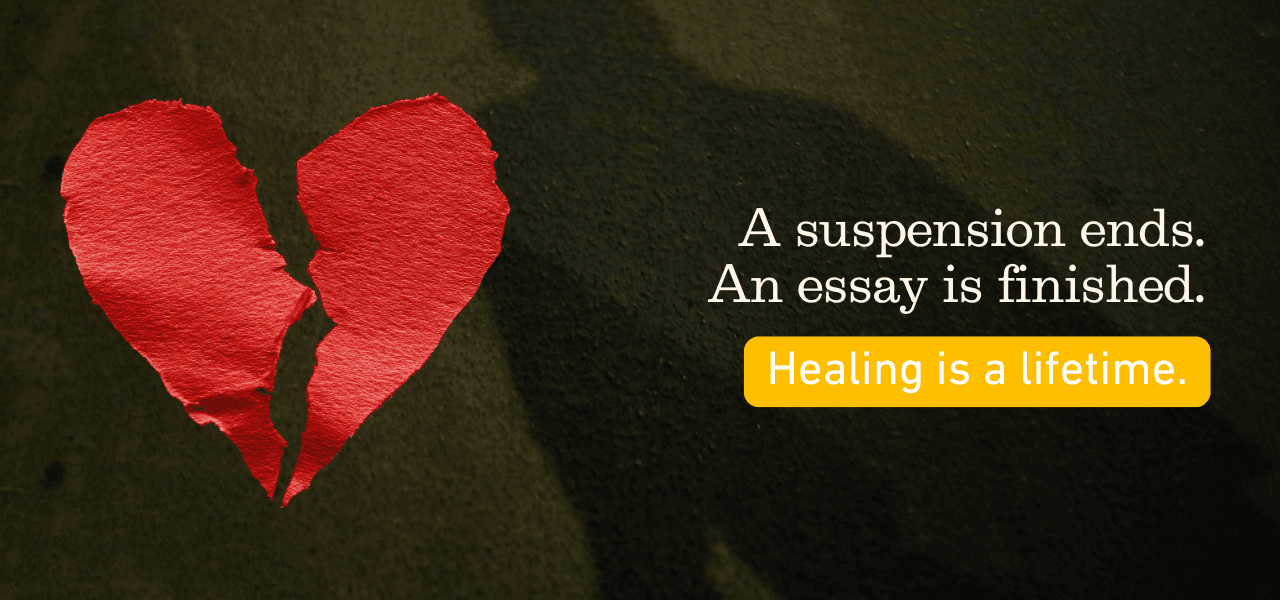
An assignment can be finished and a suspension can end, but neither puts an end to the consequences she lives with. Whatever happens in court, she is the one left trying to feel safe, rebuild trust and live with the trauma of something other people chose to do to her. She should never have had to learn how to live with any of this. And if she builds a beautiful, happy life, that will not mean the harm was temporary or that the consequences were enough. Her healing will never make what happened to her less serious.




…
…