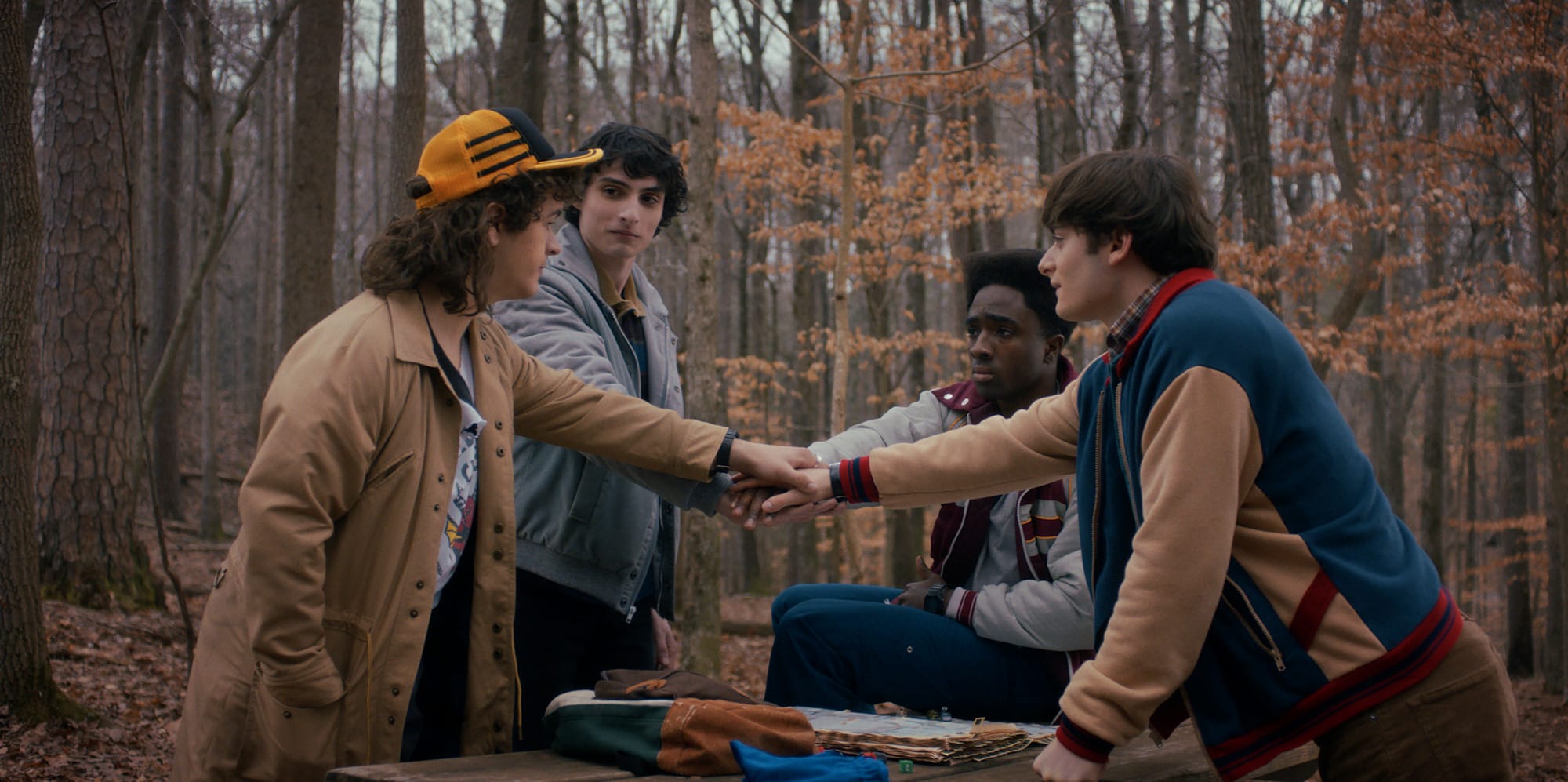
I watched the Stranger Things series finale last night (December 31, 2025), and I swear my nervous system is still doing that thing where it can’t tell if it’s processing grief, joy, nostalgia, or just the lingering echo of synthesizers in my bloodstream.
It feels almost funny to say “finale” out loud, because this story didn’t just run. It lived alongside us. It stretched across nearly a decade and got sandwiched by a pandemic that permanently changed the face of the world. Netflix even released the final season in a way that mirrored modern life, in pieces, in pauses, in waves. Vol. 1 on November 26, 2025, just in time for Thanksgiving. Vol. 2 on Christmas. And the finale on New Year’s Eve.
And for me, it wasn’t just a sci-fi horror series about monsters and portals. It was a mirror. It was a time machine. It was a love letter to friendship, and a reminder that the scariest things are often the things we can’t see.
Like what kids carry when adults aren’t paying attention.
Rainbow Brite, Strawberry Shortcake, and the other stuff
The show takes place in the 1980s, and I grew up in the 80s. Some of my childhood really was bright and sweet. Rainbow Brite. Strawberry Shortcake. Bike rides. Cassette tapes. The kind of freedom that makes today’s parents clutch their pearls so tightly they risk creating diamonds. Can pearls turn into diamonds? I digress, but you get the analogy, right?
But I also dealt with real-life villains. Not the theatrical kind with claws and slime. The murky kind. The vile kind. The kind that looks normal in the daylight, and that’s what makes it worse.
Watching Stranger Things, I kept thinking about how often, back then, adults didn’t know what was going on. Not because they didn’t love us. Not because they were monsters. But because they were tired. Distracted. Stuck in their own survival mode. They didn’t always have the words, and often didn’t have the tools to find them.
And so kids dealt with a lot on their own.
That’s a tender thing to say out loud because it can sound like, “There were a lot of shitty parents out there.” And I’m not trying to host a generalized parent-bashing session. Because I don’t believe it was like that. Yes, there were commercials literally telling parents it was 10 pm, and they should go look for their kids. But I believe a lot of 80s parents were honestly trying to be different from their parents, people who sat at dinner tables where you ate everything on your plate and didn’t speak unless spoken to.
We, at least, were taught to speak up, but not to say anything unkind.
“Nice words or no words.”
And sometimes I wonder which is worse. Being told your voice doesn’t matter, or being told your voice only matters if it’s agreeable. But isn’t the intent of those words a positive one? I think so, I think it is. If you don’t have something nice to say, don’t say anything at all. And in some cases, that works. If I don’t like someone’s dress, I don’t have to tell them.
The 80s were full of contradictions like that. Freedom mixed with silence. Fun mixed with fear. Bright colors wrapped around hard truths.
Which is exactly why Stranger Things hits so deep.
Growing up feels like the Upside Down inside the house
One of the most real things Stranger Things does is show how kids often live in two worlds at once.
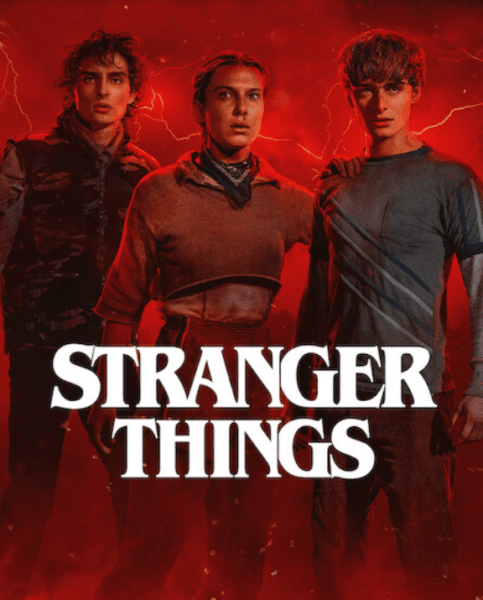
The world adults can see.
The world kids survive in private.
That private world can feel like an Upside Down. Alien, terrifying, lonely, and also weirdly familiar. You’re walking through it thinking, am I the only one here? Is anyone going to notice? Does anyone care enough to come find me?
And the answer, for so many of us, has been complicated.
Because sometimes parents honestly did not know. Like Joyce Byers, she was dealing with her own issues; she didn’t notice Will was missing. It took the worst to happen before she was able to be present as his Mom. And sometimes they did know, at least enough to sense something was wrong, or enough to hear a name, a hint, a half-truth said with shaking hands. But many parents lacked the tools, language, resources, or support systems to deal with what they were hearing. So they minimized it. They brushed it under the rug. They told themselves it wasn’t that bad, or that it would pass, or that making a “big deal” would somehow make it worse.
They did not realize how deeply pain can embed itself when a child’s developing years are spent surviving things they were never meant to quietly endure.
So yes, adults do care. But caring without communication doesn’t always land. Caring without action doesn’t always protect. And a child can be brave and still be harmed. A child can speak up and still learn the lesson, “This doesn’t matter enough for anyone to help me.”
That’s why the show’s real message isn’t “monsters are bad.” We already know that.
The message is, pay attention to each other. Listen all the way through. Believe what you hear. Then do something with it. And don’t let that something be judgment.
Tell the truth. Ask questions. Believe people when they’re scared. And for the love of all that is holy, don’t let the quiet kid carry everything alone.
“Friends don’t lie” is cute and also a whole survival strategy
We are not living in Hawkins. We are not fighting demogorgons.
But we are living in a world that can flip from safe to horrifying in a heartbeat. One day we’re in our own bubble, and the next day we’re trying to understand school shootings, violence in churches, terror and destruction at home and abroad.
A lot of life lately has felt upside down.
So no, we don’t need a spiked bat and a flamethrower. But we do need honesty. We need courage. We need communication. We need to know who our people are, our real people, and we need to show up for them before things get catastrophic.
Because “Friends Don’t Lie” isn’t just a line. It’s an ethic. It’s an agreement. It’s a life raft.
Why the human villains matter
There were so many things I appreciated about the finale, threads tied up, emotional arcs honored, characters allowed to breathe.
And still, one thing bugged me. I wanted more resolution about Dr. Kay and her military minions. Because if you’re going to unleash a human villain with that level of cold, clinical ambition, I’m going to need some consequences, please and thank you.
And yet, maybe that’s part of the point. Some villains don’t get a neat ending. Some systems don’t collapse as cleanly as a monster does. Dr. Kay represents the kind of evil that isn’t dramatic. It’s bureaucratic. It wears a badge. It files reports. It tells itself it’s necessary.
There’s another reason Dr. Kay hits a nerve for me, and it’s bigger than Hawkins.
The Duffer Brothers have shared that Hawkins Lab was loosely inspired by real Cold War era experimentation, the kind of “the end justifies the means” thinking that turns human beings into projects.
That matters, because it reminds us that the scariest monsters are not always supernatural. Sometimes they are policies. Sometimes they are credentials. Sometimes they are people in lab coats who believe the outcome matters more than the person in front of them.
And if you grew up anywhere near the 70s and 80s, you also know this truth. There was a time when parts of medicine and mental health culture treated “different” like something to correct, instead of something to understand. There were forms of aversion therapy that used pain, including electric shocks, to try to extinguish LGBTQ identity and behavior. In the broader history of behavior modification for disabled and neurodivergent kids, punishment and aversives were not rare in that era, including the use of electric shocks in some approaches and institutions.
I am not saying every doctor did this. I am saying it happened, and it should teach us something that still matters in 2026. Ethics is not a bonus feature. Compassion is not optional. Informed consent is sacred. And acceptance can be life-saving.
Because you do not “shock sense” into a child who is struggling, sensitive, different, or trying to survive. You do not punish someone into becoming acceptable. You do not make a person whole by teaching them to hate themselves.
You listen. You learn. You protect. You help them build a life where their nervous system can finally unclench.
That is the opposite of Hawkins Lab. That is the point.
And that’s why some of the most terrifying villains are the ones who keep going after the smoke clears.
That’s real life. Unfortunately.
Millie Bobby Brown: the raw humanity of Eleven, aka Jane
Before I talk about the relationships that kept people alive, I need to say this clearly. Millie Bobby Brown is brilliant.
Because Eleven, aka Jane, could have been played like a concept. A superpowered kid. A trauma storyline. A plot device. But Millie made her a person, fully. She gave Eleven a soul you could feel. The kind of performance where you don’t just watch what happens to a character, you watch a human being try to become whole in real time.
The raw emotion she brings is not noisy. It’s specific. It’s in the way she looks at people like she’s learning trust from scratch. It’s in the way she holds grief in her body, like it has weight. It’s in the way her strength never cancels out her softness. She makes you believe that power and tenderness can live in the same skin.
And I also know this is not the end of the line for her. I’ve seen her as Enola Holmes, so I know she’s not trapped inside one role. She has range. She has spark. She has that rare thing where you can tell she’s going to keep growing, and we’ll get to witness it.
But Eleven will always matter. Because Millie didn’t just portray her. She personified her. She turned a girl raised in a lab into someone we all fought for, cried for, and recognized. That’s not just acting. That’s alchemy.
Also, that’s emotional heavy lifting in a buzzcut, and she did it like a champ.
The relationships that kept people alive
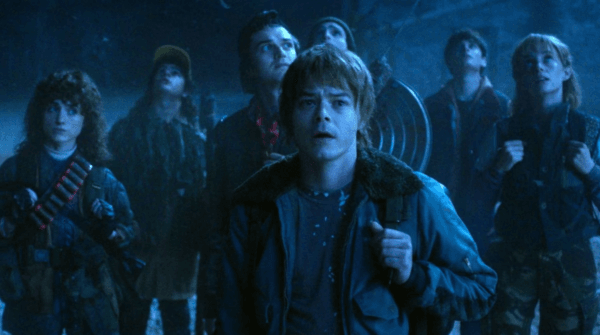
If you want proof that the real magic of this series was never just the monsters, look at the relationships that kept people alive. The ones that taught us how to be human in the middle of the impossible.
El and Max: the softness that saves
One of the relationships that stayed with me most was El and Max. Not because it was perfect, but because it was real. El did not grow up with the normal practice of friendship. She grew up in survival mode. Max met her there and still offered her something gentle and ordinary, which is actually extraordinary when someone has lived through trauma.
Their friendship gave El a doorway into girlhood, into laughter, into the simple magic of being chosen without being used. It was a reminder that healing is not always some big dramatic breakthrough. Sometimes healing is a friend sitting beside you and saying, you don’t have to do this alone. Let’s go to the mall, try on geometric patterns, rock a side ponytail, and eat some ice cream.
Mike and El: love that chooses hope
Mike and El have always felt like the heartbeat under all the chaos. Not because it’s some shiny fairytale romance, but because it’s love built on belief. Mike sees El as a person before he sees her as a weapon. He talks to her like she matters, even when the world is treating her like an experiment, a solution, a thing. And when you grow up feeling like you only matter if you’re useful, that kind of love changes the shape of your life.
“I love you on your good days. I love you on your bad days.”
(Mike to Eleven, Stranger Things Season 4, Chapter 9, “The Piggyback.”)“You understand me. Better than anyone. You always have. From the day we met… you’ve seen me.”
(Eleven to Mike, Stranger Things Season 5, Chapter 8, “The Rightside Up.”)
What hit me hardest in the finale is how Mike chooses hope out loud. Not with proof. Not with control. Just conviction. He believes in her, and he believes she is more than what was done to her. That’s a different kind of courage than swinging a bat. It’s the courage of staying tender in a world that keeps trying to harden you. It’s the courage of love that doesn’t demand certainty. It just says, I’m here, I’m not leaving.
It also made me cry hard in the end.
Hopper and El: the kind of love that keeps returning
Hopper and El are not a neat, picture-perfect father-daughter story. They are a scarred, stubborn, deeply human one. Two people who have been through too much, who have both lost too much, who found each other anyway.
That’s why the finale montage of memories had me sobbing. Not because I am fragile, although sure, sometimes I am, and proud of it. It hit because their bond was built in the middle of chaos, and then life asked them to face the same kind of loss again. After everything Hopper has endured, after everything El has survived, neither of them deserved to be dragged through that kind of pain at the end.
I understand why it had to happen. Stories like this demand a price, and sometimes the price is the thing you most want to keep. But I still feel it in my chest, this grief for them. Because Hopper loved her like she was not a weapon, not a project, not a mistake. He loved her like she was a kid who deserved a home, rules, safety, and waffles, and someone who would keep coming back for her no matter what.
“I’m so proud of what you’ve overcome. I’m proud of who you are. I love you, Jane.”
(Hop to El/Jane, Stranger Things Season 5, Chapter 4, “The Sorcerer.”)
That’s the magic of their relationship. Not perfection. Persistence. Love that gets knocked down and still gets back up. Love that says, I am here, even when the world is upside down.
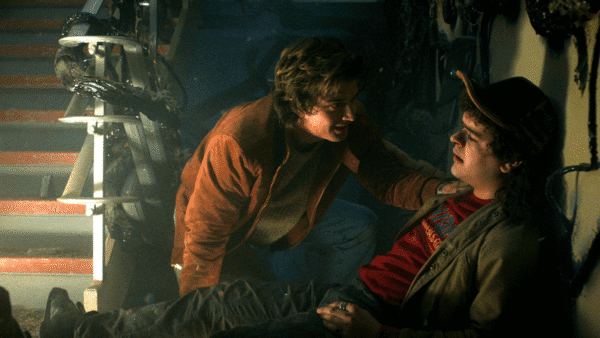
Dustin and Steve: If you die, I die
And then there’s Dustin and Steve, the pairing that should not have worked, and yet somehow became one of the most emotionally dependable relationships in the whole series. Their friendship is hilarious, yes, but it’s also deeply reassuring. Steve doesn’t just protect Dustin with his body. He protects him with attention. He listens. He shows up. He stays. Steve is basically a human shield with great hair and surprisingly excellent emotional availability, which, honestly, is rare in any decade.
Steve: “I got angry… because I really missed you. I missed my best friend.”
Dustin: “Yeah. I missed my best friend, too.”
(Steve and Dustin, Stranger Things Season 5, Chapter 7, “The Bridge.”)
And we know Dustin’s mom loves him. We just didn’t see her often. She seemed like a single mom who was probably working her butt off, trying to keep the lights on and the kid fed, which is its own kind of heroism. Still, there’s something so meaningful about the way Steve steps into that “older brother” role without making it weird or controlling. He doesn’t talk down to Dustin. He doesn’t try to shrink him. He just gives him what so many kids quietly need, someone steady who takes them seriously.
The synergy between them is proof that “older brother energy” can be gentle. That masculinity can look like patience, loyalty, and showing up even when you’re terrified. That being a safe person, the kind who says “I’ve got you” and actually means it, is one of the most heroic choices anyone can make.
Also, if we’re being honest, Dustin and Steve are the definition of “If you die, I die,” except it’s delivered with bickering, panic, and the vibe of two people who would absolutely roast each other while actively saving the world. Which is, in its own way, sacred.
Lucas and Max: so much more than a Kate Bush soundtrack
And Lucas and Max. People love to talk about Max with the Kate Bush soundtrack, and I get it, because that music scene became iconic for a reason. But Max and Lucas are so much more than that.
They are the kind of young love that carries real weight. Lucas is not just a boyfriend who wants to be liked. He is a person who chooses to stay close even when Max pulls away, even when grief makes her sharp, even when she is trying to disappear inside herself. He keeps coming back with steadiness instead of ego. He loves her in a way that says, I am here, even if you cannot be here yet. He sits at the hospital holding her hand while she is in a coma, and then he risks his life to carry her away once Vecna learns where her body is located.
That is not a playlist moment. That is devotion, and it is the kind of devotion that can help someone survive their own darkness.
And speaking of emotional maturity, the finale gave us one of the healthiest conversations I’ve ever seen between two men on television.
The scene that made me whisper, “YES. THIS.”
There’s a moment after Jonathan saves Steve where they talk honestly about Nancy. About how they both love her. About how special she is. About how sometimes it’s better to have someone as a friend than to keep dragging everyone through the chaos of trying to “win” them.
God. Damn.
That dialogue was so mature, I wanted to pause the show and assign it as homework to half the planet.
People everywhere should learn from that.
Not because it’s about romance. But because it’s about the rare and wildly underrated skill of naming the truth without turning it into a weapon.
And you can feel what that kind of honesty does in a group. It doesn’t weaken them. It clears the air. It makes the room safer.
That’s the kind of courage we need more of.
Nancy isn’t a prize. She’s a force.
Nancy’s journey is one of the most compelling things in the whole series, and part of what made that conversation hit is that Nancy has never been written like an object. Even when people try to reduce her to a triangle, Nancy keeps showing up like, “I’m actually busy trying to survive and save the world, thanks.”
Natalia Dyer has said Nancy has bigger problems than romance. Exactly. Nancy is a journalist at heart. A truth-seeker. A fighter. Someone who won’t let you look away.
I would watch a Nancy spin-off in a heartbeat. Give me Nancy chasing stories, breaking cases, holding power accountable, refusing to be dismissed. That’s not a “side character.” That’s a whole path.
Steve from hair to heart
Yes, Steve gets his own section, because he truly is a pivotal character who looked after everyone.
Joe Keery has talked about how satisfying it was to see Steve go from being the “observer” to being central, needed, part of the plan. And that’s Steve in a nutshell. The guy who could have stayed shallow, but chose depth.
Steve’s heroism isn’t flashy. It’s consistent. And I saw so many memes and posts begging the writers not to kill Steve. They definitely teased us with that, but they saved him and that was so needed. Especially after what happened with Eddie in Season 4. Oooph, that one still stings.
Steve shows up, again and again. He protects. He changes. He keeps loving people even when it hurts. That’s not just character growth. That’s the kind of growth we’re all being asked to do in real life.
Will and Robin: the bravery of being seen
One of my favorite bonds this season was Robin and Will.
I loved that her courage gave him courage.
“I was looking for answers in somebody else, but I had all the answers. I just needed to stop being so goddamn scared.”
(Robin to Will, Stranger Things Season 5, Chapter 4, “The Sorcerer.”)
Noah Schnapp has spoken very openly about how emotional and personal it felt to play Will’s truth. How he cried reading it. How genuine it was to his experience. How he prepared deeply so it could be real and not performative. That matters. Because coming out isn’t just a plot point. It’s a threshold.
And in the 80s, that threshold could feel more terrifying than a monster.
What made it beautiful wasn’t just that Will came out. It was that love met him there. That his friends and family accepted him. That he was hugged, not punished. That the show didn’t turn his truth into a tragedy.
It treated it like what it is. A release. A return to self.
Hopper and Joyce: trauma love or true love?
Okay, let’s talk about Hop and Joyce getting engaged.
I don’t know how I feel. I’m happy for them, obviously. But I also wonder. Can a relationship survive when it’s no longer fueled by adrenaline and crisis?
Because trauma creates intensity, and intensity can look like romance. The question is, when the monsters are gone, when life gets quiet, can the love still stand?
I hope so. I want it for them. I just also want them to have therapy. Like, a lot of therapy. This is not snark. This is me being pro-love and pro-mental health at the same time.
Side quests I still have feelings about
A quick moment for the characters who feel like side quests, but still left fingerprints on my heart.
First, Kali, aka Eight. I know her power was supposedly necessary, and on paper she should have been this powerful mirror for El. But emotionally, she never fully landed for me. For a while, I genuinely thought she was working with Henry and was going to be the thing that blew up their plan, because her energy always felt like it had one foot in “helpful” and one foot in “here comes the betrayal.” I was surprised when she died. Not because I needed her to live, but because I kept waiting for her full Grinch moment, that heart-change where she stops circling connection and actually chooses it. It came too late for me to trust it.
Now, the side quests I loved with my whole chest. Murray, who remains chaotic good in human form and somehow becomes emotional support, comic relief, and problem-solver all at once. And then Mrs. Wheeler, who absolutely earned her own cape when she shoved an oxygen tank into the dryer and took out demodogs like she was doing laundry and exorcism at the same time. That was such a badass moment that I stood there thinking, “I love this for her,” immediately followed by, “She really should be dead… how did she survive that attack?” The only answer I can come up with is mom superhero powers, plus Hawkins-level plot armor, and honestly, I’m fine with that.
This reflection is already long, so I’m not trying to recap everyone. I just want to honor the truth that even in a story filled with monsters, the unexpected people still show up with a flashlight, a wild plan, or a dryer full of justice.
The music did what music always does: it opened the vault
And then there was Prince.
Netflix has said the finale’s needle drop was built around Purple Rain, with “When Doves Cry” and “Purple Rain” shaping the emotional arc. And if you grew up in the 80s, you know this isn’t just soundtrack. It’s memory.
Music doesn’t just play in the background. It opens a door inside you.
So while the characters were fighting for their lives, I was also fighting my way through time, back to the kid I was, back to the things I survived, back to the ways I learned to “suck it up and figure it out.”
Which we did. By and large, we did.
And now we’re parents.
And we’re trying to do better. Not because our parents were villains, but because we understand more now. We teach boundaries. We teach consent. We tell our kids they don’t have to hug anyone they don’t want to hug. We build hula hoops of safe space. We normalize therapy. We tell them, you can come to us with anything, and if you can’t, you can go to a counselor or a teacher or a therapist.
Because love that can’t be talked about isn’t safe love.
The ending: faith as an act of strength
At the end, Mike has a theory. And I loved it.
I agree with Mike. And Will. And Lucas. And Max. And Dustin. I like believing that El is out there finding her peace and her waterfalls. I like that it’s okay to believe something with conviction even when you can’t prove it.
I like that the ending gives us permission to choose hope on purpose. Not because it’s easier, but because it’s necessary.
Because some people act like hope is naive, like it’s a cute accessory for people who don’t understand how the world works. But hope is not denial. Hope is not ignorance.
Hope is a decision.
Faith is powerful.
And right now, hope is necessary.
Everyday heroism is the point
When I think about why Stranger Things resonated with me, I don’t think it’s because I want to fight monsters. I think it’s because I want what the characters have.
Friends who show up.
People who tell the truth.
Courage that doesn’t require perfection.
Love that doesn’t demand you shrink.
A tribe that makes you feel like you can breathe.
The magic isn’t in never getting hurt.
The magic is in being knocked down and then always, always, always getting back up.
And then going to play one final game of Dungeons & Dragons, because joy is not optional. Joy is part of survival.
So yes. A sci-fi horror series got under my skin and did some healing work I didn’t expect.
How crazy is that?
Also, how perfect.
Friends don’t lie.
And your voice does not exist to keep other people comfortable.
Tell the truth, even when it shakes. Say the kind thing, yes, but do not confuse kindness with silence. Be brave enough to name what happened. Be brave enough to ask for help. Be brave enough to believe someone else when they do.
If the world feels upside down, hold onto your people. Keep choosing hope on purpose. Keep getting back up. Then reach back and help someone else stand.
Mage out.