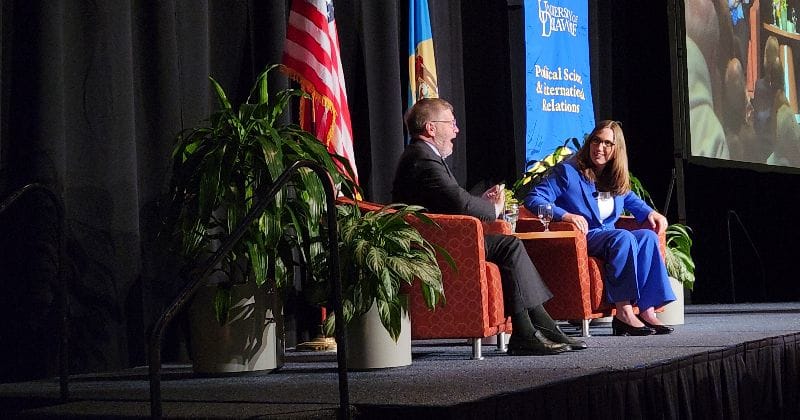
Tonight I sat in a room at Clayton Hall at the University of Delaware and felt something I haven’t felt in a long time: called in, not called out.
Congresswoman Sarah McBride gave a lecture titled “Freedom to Hope in an Age of Cynicism,” and I knew I’d be moved because she is a powerful speaker. I did not expect to walk out rethinking my own patterns, my own reactions, and, honestly, my own weariness.
Her speech was compelling in a way that gently grabs your shoulders and says, “You can do better, and it matters that you try.”
The part that hit me hardest
Sarah spoke about a behavior many of us fall into without noticing: treating disagreement as a personal betrayal. What I would call cancel culture, she described as something deeper and more dangerous. It is the habit of using relationships to punish or reward based on political or social alignment.
If you agree with me, we are fine. If you do not, then goodbye.
It sounds dramatic when phrased that plainly, but tell me it does not ring true. I have seen it. I have felt it. I have participated in it in ways that do not reflect the person I want to be.
Sarah’s point was painfully clear. When we cut people out because they disagree, we close the door on the possibility of changing minds, including our own. Democracy cannot survive if we stop talking to each other.
Social media is not helping
Sarah talked about how algorithms push us into bubbles where our own opinions echo back at us. We scroll and see our beliefs reflected again and again. It feels good and safe, but it teaches us nothing new.
That false sense of “everyone already agrees with me” makes it even easier to shut down, shut out, and shut off anyone who does not.
It is easier to cancel than to converse.
It is easier to be cynical than to be hopeful.
It is easier to scroll than to engage.
But easy paths rarely move us anywhere worth going.
Hope and optimism are not the same
Sarah said something that will stay with me for a long time.
Optimism shifts with our circumstances. Hope does not.
Optimism wavers when the world wavers.
Hope stays steady because it is not about what is happening; it is about what could happen if we keep trying.
I realized I have been confusing the two.
Optimism has been hard for me lately. It evaporates quickly. One painful conversation, one misunderstanding, one heartbreak, one headline, and it is gone. But hope, the quiet kind, the grounded kind that grows slowly if you care for it, is still there. And that is something I refuse to give up.
What this made me see in myself
Listening to her talk about persuasion, grace, messy coalitions, and imperfect allies, I felt a sting of recognition. I have been tired. Truly tired. I have been hurt by people who do not meet me with the same sincerity I try to offer. In that exhaustion, I have started to retreat. I have shut down. I have tried to protect myself with distance or cynicism that feels like armor but behaves more like poison.
Her message challenged all of that.
She was not asking anyone to tolerate harm or overlook injustice.
She was asking us to resist the impulse to give up on people entirely.
Because when we give up on people, we are not only giving up on them. We are giving up on democracy, community, possibility, and our own ability to grow.
The most hopeful line of the night
Sarah said, “Most people are good and decent people.”
Hearing that from someone who has every reason to doubt it cracked something open in me. The loudest voices online are rarely the kindest or most thoughtful. Algorithms reward outrage, not empathy.
But real life is still full of people who are trying, learning, and wanting to do right.
Where I landed after tonight
I walked out of Clayton Hall feeling softer than when I walked in.
Not naive.
Not blindly optimistic.
Just open.
Open to sitting at tables where not everyone thinks like me.
Open to conversations that feel uncomfortable at first.
Open to grace for imperfect allies, including myself.
If hope is the steady thing, the thing that does not change even when everything else does, then maybe the work is to choose it with intention. To choose it over cynicism, over dismissal, over silence, over the easy out.
Tonight reminded me that democracy depends on that choice, and so do connection, healing, and every small bit of growth we cling to.
And honestly, I needed that reminder more than I realized.