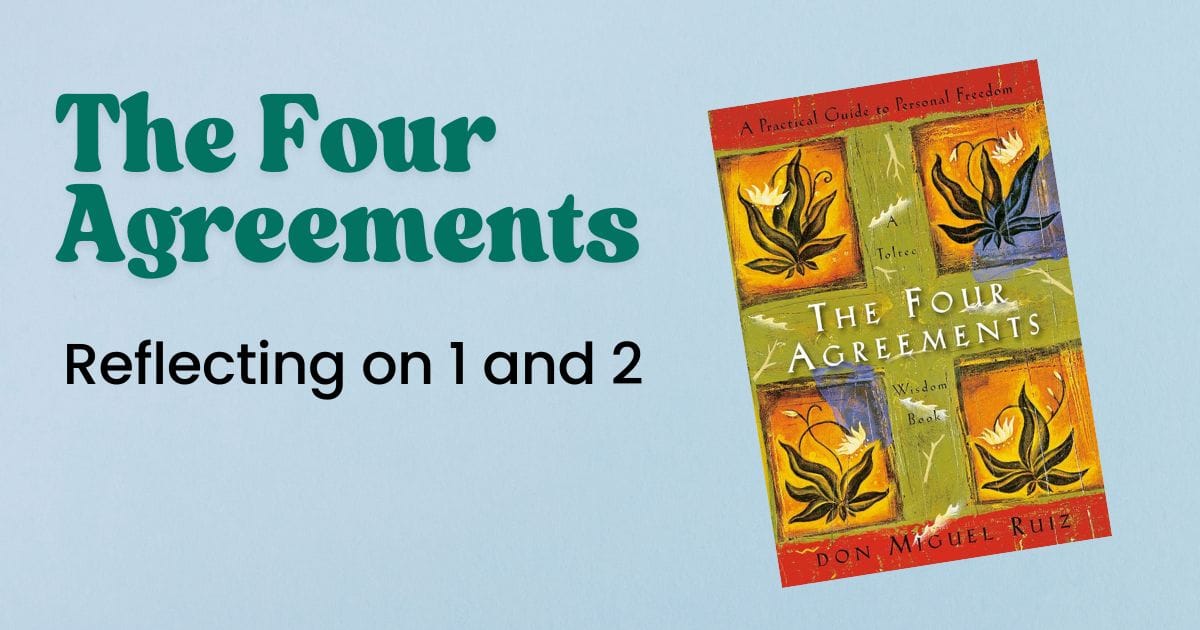
My therapist brought up The Four Agreements, by Don Miguel Ruiz, today while we were talking about difficult conversations. It is a book I have read more than once, I’m familiar with it, but I definitely needed the reminder today.
She explained that every person receives communication through their own filters. What they hear is shaped by their life experience, their mood, their stress level, whether they slept the night before, and whether my words brush up against something tender, or perhaps unresolved. So even when I speak with care, my words may not always land in neutral territory. They may land inside another person’s real life, which includes whatever they have gone through or whatever they are currently enduring.

The Four Agreements make you think about your words
The first agreement, be impeccable with your word, sounds simple until you are actually trying to live it. Then suddenly you are choosing words carefully, trying not to accuse, trying not to soften the truth so much that it disappears, and trying to stay honest without becoming harsh.
What helped me today was thinking about “impeccable” as accountable, not perfect. I do not think it means I will always say everything beautifully. I think it means I am responsible for trying to speak with honesty, care, and as little harm as possible. I’m not perfect; there have been many times when I speak impulsively without thinking. They say hindsight is 20/20, after all.
That matters, especially when conversations involve pain, power, or consequences. Words can protect people, and words can also corner them. Words can clarify, and words can also erase. When we are talking about immigrants, marginalized communities, trauma, grief, race, class, disability, gender, faith, or survival, language is not just decoration. Language decides who gets believed, who gets blamed, and who gets asked to carry the discomfort.
So yes, I want to be kind, but I also want to be clear.
Honest communication still has to survive other people’s filters
The second agreement, do not take anything personally, is the one I had to sit with for a minute. At first, it can sound like it is asking me to detach from the impact of my words or pretend that hurt feelings do not matter. That is not something I can get behind.
But the way my therapist explained it gave me something more useful. She was not telling me to ignore impact or act like words do not hurt. She was reminding me that another person’s reaction is shaped by more than my intention.
That does not excuse harm. It does not mean I get to say whatever I want and then blame the other person for how they received it. Accountability still matters. Repair and care still matter.
It does mean that communication is never clean math. I often say that very few things in life are black and white. I can say something with care, and someone can still hear criticism. I can name a boundary, and someone can hear abandonment. I can ask for accountability, and someone can hear rejection. Sometimes that is because I need to communicate better. Sometimes it is because their history is standing between us.
Often, it is both.
The hard part is caring without collapsing
Here is the thing. Understanding, or trying to learn about, someone else’s filters does not mean abandoning my own reality.
I can care about how something landed and still know what I meant. I can apologize for harm without apologizing for having a need. I can listen to someone’s pain without volunteering to become the villain in their version of the story.
That distinction matters to me because I know how easy it is to confuse compassion with self-erasure. A lot of us were trained to believe that being loving means being endlessly available, endlessly understanding, and endlessly willing to make ourselves smaller so nobody else feels uncomfortable.
That is not love. That is a hostage situation with nicer lighting.
Real compassion has a spine. It asks me to care about my impact, tell the truth, and stay connected to my own dignity. It asks me to notice who gets hurt when people avoid hard conversations, especially the people who are already expected to absorb discomfort quietly.
Because silence is not always neutral. Sometimes silence protects power. Sometimes silence teaches the most vulnerable person in the room that everyone else’s comfort matters more than their safety.
Difficult conversations reveal what a relationship can hold
I think one reason difficult conversations scare me is that they show me the truth about the relationship. Not the polite truth. Not the “we should totally get coffee soon” truth. The real one.
When I am honest with someone, I find out whether there is room for both of us in the conversation. I find out whether we can misunderstand each other and still care enough to repair it. I find out whether I can say something hard without being punished for not wrapping it in enough bubble wrap first.
And I find out whether the other person can tell me how I affected them without handing me every wound they have ever carried and calling it an invoice. And this goes both ways. Because I, too, have a difficult time letting go of things where I have felt wronged. They stay with me and I know I give them too much power.
So, naturally, this part is hard for me. Family and friendship matter to me, but I am learning that boundaries matter, too. I want relationships where honesty is not treated like betrayal. I want there to be room for awkwardness, repair, and growth. I want the kind of connection where someone can say, “That hurt,” and I can say, “Help me understand,” without either of us reaching for a flamethrower or screaming.
Not every relationship can hold that. Sometimes the conversation reveals care. Sometimes it reveals avoidance. Sometimes it shows me that I have been working overtime to maintain peace with someone who benefits from my silence.
That is painful information, but it is still information.
I am learning that impact matters, and so does intention
The more I sit with the first two agreements, the more I see that they are not opposites. Being impeccable with my word asks me to take responsibility for what I say. Not taking things personally asks me to remember that I am not the decision maker of how someone receives it.
Both can be true.
If someone tells me my words hurt them, I want to listen. I want to understand what happened. I want to repair what I can. I do not want to hide behind good intentions, as if they are a permission slip.
But I also do not want to hand over my entire sense of self every time someone reacts strongly. A reaction can be real without becoming a printed line in the way I am defined. A feeling can deserve care without becoming the final ruling on my character.
That feels important, especially for those of us who learned to scan every facial expression, every text response, every shift in tone, and immediately assume we were in trouble. There is a difference between being accountable and being emotionally drafted into someone else’s weather system.
I am trying to learn that difference.
The invitation is to stay honest and stay human
The Four Agreements will not magically make difficult conversations less difficult. I am still a person, not a spiritually enlightened customer service kiosk.
But the first two agreements gave me a clearer frame. I can be careful with my words. I can care about my impact. I can remember that people hear me through their own filters. I can stop treating every misunderstanding as proof that I failed.
That does not mean I become careless. It means I stop confusing control with responsibility. Novel, right?
My responsibility is to speak with honesty, care, and accountability. My responsibility is to listen when someone tells me how my words landed. My responsibility is also to stay rooted in what I know to be true, especially when a difficult conversation gets messy. Additionally, it is my responsibility to be clear and honest, which sometimes means admitting I was wrong.
And maybe that is the invitation. To tell the truth without cruelty. To listen without collapsing. To care about other people’s filters without making ourselves disappear inside them.